


The noise surrounding Artificial Intelligence (AI) is deafening. You hear “AI, AI, AI” everywhere, and the insights gathered this week might feel obsolete by the next. Ignoring this accelerating technology is not an option for your career or for your organization’s growth. This moment requires CISOs to step up, move beyond the hype, and get ahead of the power curve.
We are currently deep in the AI hype cycle, where many organizations are utilizing this technology and discussing it without fully understanding how to maximize its true value. This widespread rush, characterized by overspending and poor optimization, is almost certainly leading toward a trough of disillusionment. Leaders will soon start questioning the millions invested for lackluster results.
To navigate this tumultuous period, the CISO must reframe the conversation. AI capability creation isn’t a magical IT task; it’s a foundational business exercise rooted in Return on Investment (ROI) calculation. The success of an AI initiative should not be measured by the number of tokens utilized or CPU cycles spent. Instead, the return must manifest as clear business advantages: greater efficiency, measurable waste reduction, new capabilities, or ultimately, a better bottom line.
Looking for a great book from CISO Tradecraft to read over the holidays?
Grab a copy of the book everyone’s talking about:
The CISO’s Mandate: Business First, Technology Second
The “C” in CISO stands for business, which means you must possess a solid understanding of how your organization generates revenue, where its key profit centers lie, and what activities keep the organization running. If you work for a nonprofit or government entity, this translates to understanding your core mission.
AI projects must start with a goal-based objective. You cannot simply ask AI to “go figure it out”. Instead, present a defined problem, such as determining which customers are ideal for an upsell opportunity using existing CRM data.
The outcomes you seek can generally be categorized using the framework of cheaper, faster, better. For example, if an algorithm can read a thousand pages in a minute compared to a human reading one page per minute, the advantage is self-evident. However, a critical warning applies: optimizing a bad process just makes that bad process faster; it doesn’t make it better. AI provides a chance to fundamentally rethink processes and may even offer insights into where existing inefficiencies lie—a shift where the tool advises you on how it can be used best.
Helpful Recommendations:
Establish AI ROI Metrics Immediately: Focus on measurable business outcomes, such as increased efficiency or new capabilities, rather than tracking technical consumption metrics like tokens or CPU cycles.
Conduct a “Cheaper, Faster, Better” Process Audit: Start by reviewing the core processes listed in your organization’s Business Continuity Plan (BCP). Systematically rate these processes based on how expensive, slow, or ineffective (low percentage accuracy) they are to identify the biggest opportunities for transformation.
Prioritize the ‘Low Hanging Fruit’ Matrix: Create a simple matrix that weighs the size of the improvement opportunity against the likelihood and confidence level of successful deployment. Focus on the quick, high-impact wins to generate positive buzz and executive reinforcement.
Stopping the AI Shadow Menace
While some executives may assume AI deployment is strictly IT’s responsibility, cybersecurity should take the lead. CISOs and their teams often grew up in IT departments and possess a deeper technical understanding of internal systems than personnel in sales or marketing. By stepping up as guides and mentors, cybersecurity can help business units achieve their visions faster, better, and more securely.
The immense risk that necessitates cyber leadership is shadow AI. Just as with shadow IT (where employees provision unauthorized cloud services), non-technical personnel may attempt “vibe coding” (using AI to generate applications or code chunks) without any knowledge of security, compliance, or sanitation. These unregulated services often fail to pass sanity checks or input validation, creating significant risk for the organization.
For example, a marketing team understands how to build a functional marketing tool but may be entirely unaware of the data privacy requirements or the strict mandates of the EU AI Act. If cybersecurity acts as a trusted advisor, partnering with business units to ensure their cool new initiatives remain within legal and regulatory frameworks, the organization can drive success while mitigating potential risks. This partnership helps ensure that marketing and sales dollars can align with cyber initiatives, securing funding and organizational support.
Helpful Recommendations:
Become the Trusted AI Advisor: Proactively engage business units, offering guidance and mentorship to help them build their AI initiatives in ways that are fast, better, and inherently more secure than if they tried to build them alone.
Integrate AI GRC into Existing Processes: Recognize that AI used improperly creates numerous nightmares for the CISO. Use your influence to establish leadership and ensure that all new AI applications are developed within the necessary framework of legal and regulatory compliance from the outset.
Securing the Evolution: From Gen AI to Agentic AI
The AI landscape is characterized by constant, accelerating change. It is vital to understand the distinct types of AI systems your organization may encounter:
Traditional AI: Primarily focused on Robotics Process Automation (RPA) to increase speed.
Machine Learning (ML): Utilizes statistics and pattern observation (e.g., throwing dice to predict averages) to predict outcomes.
Generative AI (Gen AI): Focuses on associations (like “peanut butter” following “peanut”) discovered through analyzing vast amounts of data. Gen AI allows for massive time savings, such as generating a ten-page document in 30 seconds. It also enables conversations about non-traditional topics or ideas (like the future of VibeSec compliance).
Agentic AI: The next level of evolution, where the AI moves beyond chat to interact with the physical world, executing complex, multi-step tasks (e.g., booking a full travel itinerary).
The shift to Agentic AI, especially in high-risk areas like self-driving cars, weapon systems, or medical diagnoses, requires extreme confidence in the integrity and reliability of the underlying software.
The Ground Truth Challenge
For any AI system to work, it must rely on accurate, verified data, known as ground truth. If the system relies on “ground lies” (unverified or poor data), the model’s outcomes will be terrible. This is particularly crucial in fields like medicine, where Human Assisted Machine Learning (HAML) uses human verification of medical scans to build highly accurate ground truth data sets.
A significant threat to this integrity is data poisoning. Studies have shown that a small number of malicious documents (as few as 250) placed into pre-training data can destroy a massive LLM trained on trillions of items and parameters. CISOs must ensure data provenance, filter inputs, and tightly control access to the data used for training custom models, as relying on easily accessible internal sources like a company OneDrive is a huge risk.
Helpful Recommendations:
Establish Data Provenance Controls: For any AI model that will impact safety or critical decision-making, it is absolutely crucial to verify the inputs and ensure the data has gone through an initial screening process. Garbage in leads to garbage results, which can be catastrophic in mission-critical applications.
Guard Against Data Poisoning: Implement tight access controls and governance over the training data for custom models to ensure data quality. Be aware that even minimal malicious insertions can compromise the entire model, highlighting the necessity of internal security controls.
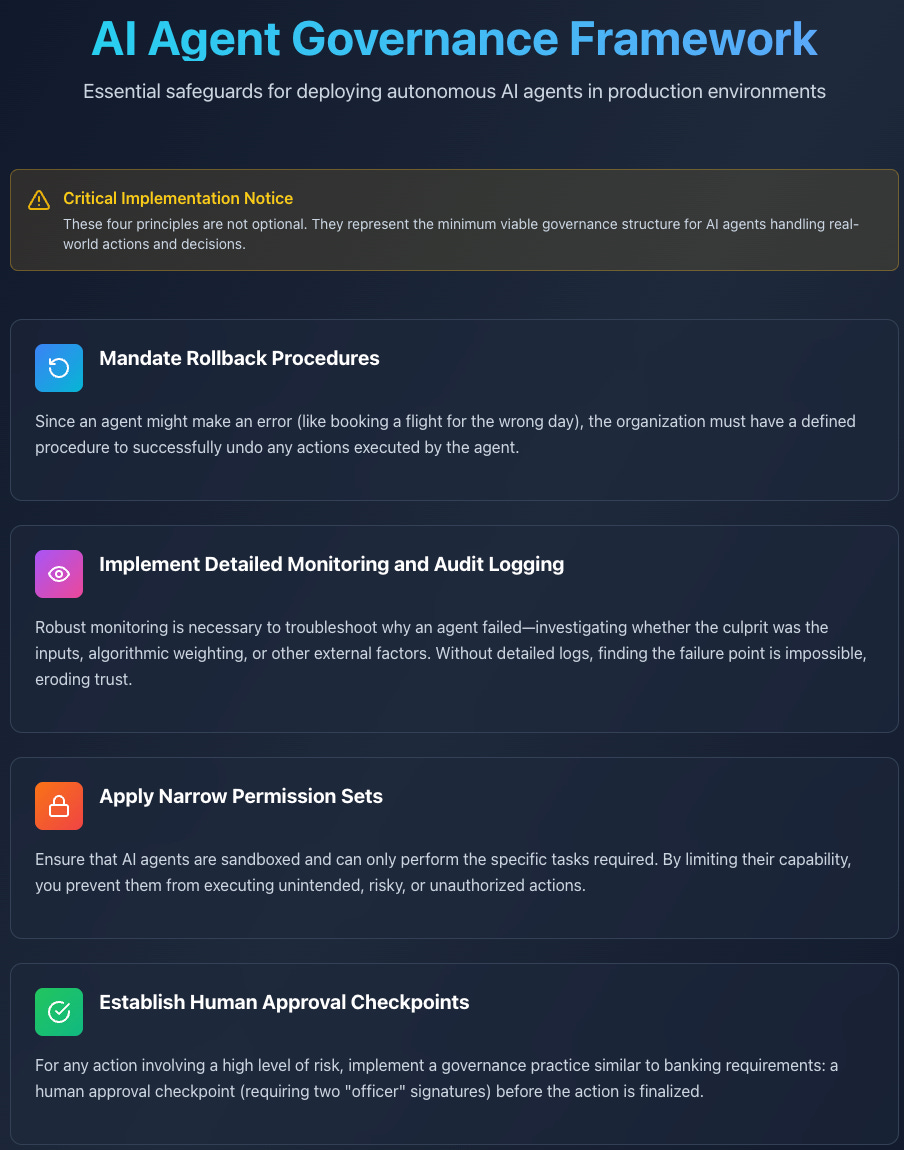
Tactical Recommendations for AI Governance: The CISO Playbook
To securely manage the rapid adoption of AI, particularly autonomous agents, CISOs need to implement specific, practical controls:
Framework and Compliance Adoption
To structure the organization’s thinking and ensure compliance, several key frameworks should be utilized:
Study the California Generative AI Intelligence Risk Assessment (SIMM 5305-F): This document is essential reading because it meticulously defines different types of data (beyond just PII), provides a checklist for minimum safeguards, and offers numerous mitigations for risks such as the inadvertent exposure of sensitive information (e.g., recommending end-to-end encryption). Given California’s history of signaling national trends in data privacy (like CCPA leading other states), this framework is critical.
Adopt Omni-Compliance Frameworks: Leverage resources like the Cloud Security Alliance’s AI Controls Matrix, which aggregates and maps various global regulations, including NIST AI 600 and ISO 42001, into 243 coherent control objectives.
Leverage Security-Focused Frameworks: Consult established, well-recognized resources such as the NIST AI Risk Management Framework, the OWASP Top 10 for LLMs, and the MITRE Atlas (which focuses on the adversarial threat landscape for AI systems).
Prepare for EU AI Act Compliance: Be aware that the EU AI Act is a risk-based framework requiring safety testing, transparency, and governance before deployment. Crucially, like GDPR, this act will affect US organizations doing business with EU citizens, carrying the threat of massive fines based on global turnover.
By implementing clear business goals, guaranteeing the use of ground truth data, and establishing robust governance for monitoring and rollback procedures, CISOs can build a process to adopt AI thoughtfully, securely, and effectively, ensuring the organization is leading the AI revolution instead of being consumed by its chaos.
The AI challenge for CISOs is not unlike steering a massive cargo ship: You can’t stop the currents (the hype cycle), and you can’t stop the speed (the technology evolution). But by securing the foundational systems (ground truth data) and installing robust navigation tools (monitoring, rollback, and compliance frameworks), you ensure the ship reaches its intended, profitable destination safely.
Spot on about the coming trough of disillusionment. Organizations are gonna realize tokens spent doesn't equal value delivered, and tht shift to ROI-focused metrics is critical for CISOs to survive the fallout. The "cheaper, faster, better" framework really helps cut through the hype and forces teams to articulate tangible business outcomes. Leadership buy-in depends on demonstratingactual waste reduction rather than just technical achievement.